
Juego de la Oca – Encrypted Guide of the Templar Knights
Known in English as “Game of the Goose,” Juego de la Oca is considered to be the first modern board game. Per Wikipedia, it began being played in Italy, and the first mention of the game was in a book of sermons published in 1480.
During the 16th century, Francis de Medici, a Grand Duke from Tuscany, gifted a copy of Juego de la Oca to King Philip II of Spain. Whether due to the beauty of the game board, the simplicity of play, of just the novelty, the king’s court abandoned chess in favor of this new pastime. Soon, the European nobility began exchanging boards, and the game spread throughout Europe.
I found one theory particularly amusing – that the game actually originated in 1600 BCE, because of the game board’s similarity to the Phaistos Disc. Given that historians believe that the repeating patterns on the disc are likely to be a hymn or incantation, we can probably discount the idea that the birds in the pattern are specifically geese.
However, a more compelling theory is that the Knights Templar invented the game in the 12th century, as a kind of encrypted map for pilgrims traveling the Camino Francés de Santiago.

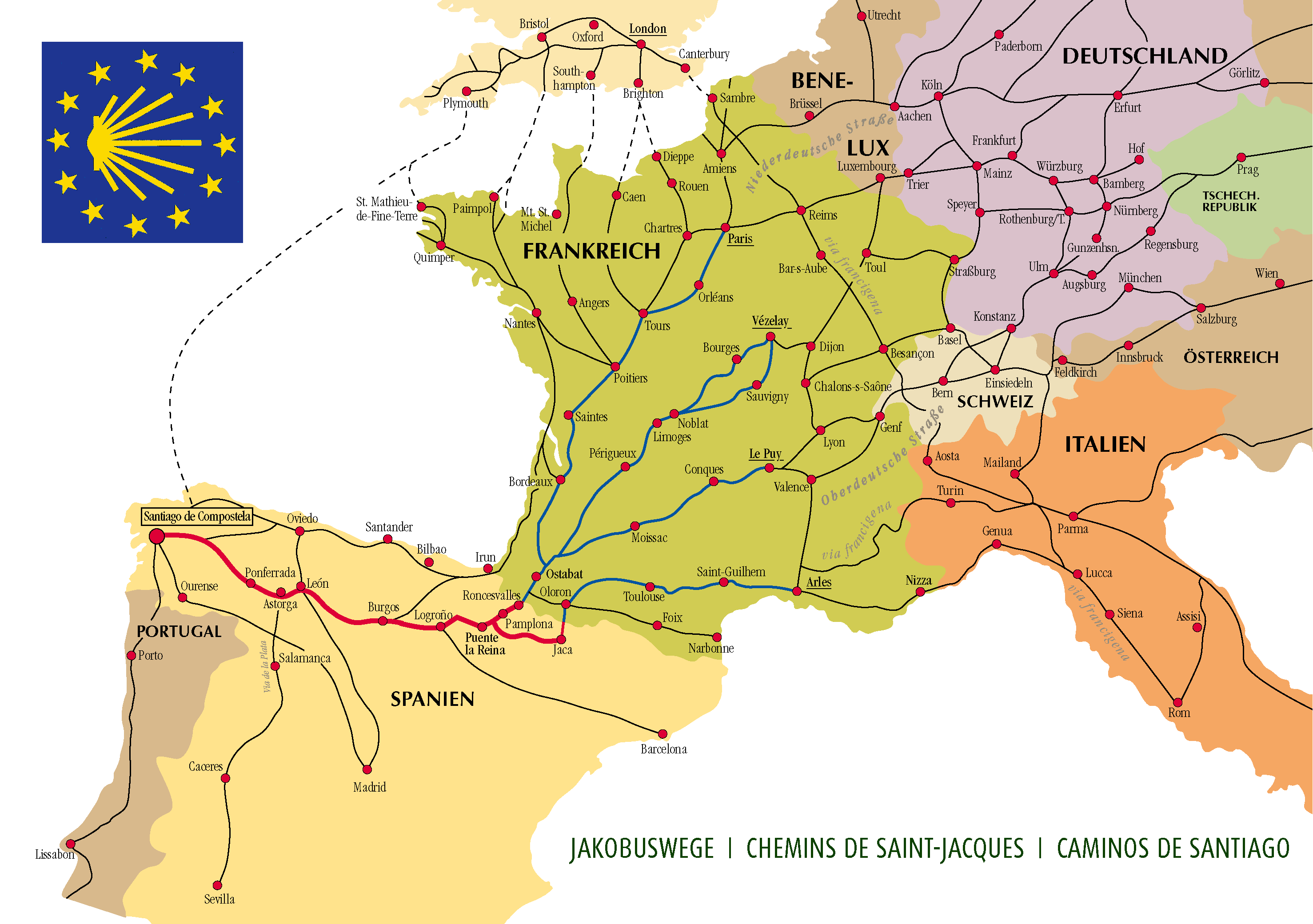
An Ancient Journey
In pre-Christian times, some Celtic tribes migrated along what would later become the Camino de Santiago across northern Spain. Some historians claim this route follows an ancient path known as the “Rainbow of Lugh” or “the way of the Wild Geese.” It’s believed that Lugh gave his name to the city of Lugo, the capital of the kingdom of Galicia.
Around 814 CE, the burial site of St. James the Elder was found where the Church of San Fiz de Solovio stands today. St. James was one of the twelve Apostles, beheaded in Jerusalem around 44 BCE, and his final resting place was unknown for centuries. After the discovery of his remains and construction of a tomb, King Alfonso II was the first known pilgrim to follow the route to Santiago de Compostela. The term Compostela, comes from the Latin componere or compositum, meaning “to bury”, or “cemetery.”
From Geese to Shells
Naturally, most towns and landmarks along the way predated the Camino. Some of them were built by a brotherhood known as the Sons of Master James. Master James (Jakin) was a stonecutter said to have been involved in the construction of Solomon’s Temple. Their symbol was a goose foot, in part because they followed the ancient Way of the Wild Geese migration route to initiate their members by carving petroglyphs in Galicia. Some buildings still bear their markings today.
Interestingly, Templar knights also regarded the goose as a symbol of wisdom. The Templar protected pilgrims walking to holy cities, such as Santiago de Compostela. Of course, they were forbidden from playing with dice. Perhaps the game began as a mere map, and later evolved into a game of chance. No one knows why the board is in the shape of a spiral, though some think it may have been inspired by a nautilus shell. The segments of the shell form a similar spiral, divided into regular segments.
Today, a scallop shell is the official symbol of the route. These shellfish are plentiful along the coast of northern Spain. Pilgrims would carry scallop shells home as a memento of their journey. Of course, if you squint carefully, you might think a shell bears a superficial resemblance to a webbed foot. But there was yet more symbolism, as when held upright, the shell’s lines resemble a sunset. Because the Camino de Santiago is a round trip, it ends back at Fisterra, a town on the west coast of Spain, whose name comes from the Latin finis terrae (Land’s End).
How to Play
At its core, Juego de la Oca is a straightforward roll-and-move racing game. Players begin the game off the board, and roll a pair of dice. Then they simply move their token that number of spaces, and if they land on a special square, they might have to roll again, jump to a different place on the board, or lose their turn.
Landing on a space with another player sends them back to the space where you began your turn. This is important to remember, as you may bounce back and forth along the board before you land. To win, you must reach the 63rd space, the Gate to the Goose Garden, which holds the secret to enlightenment. This is the end of an initiate’s path, to begin their life as one of the faithful. The catch is that you must land on this space by exact count. If you roll too high, then after touching the Gate, you must complete your movement by traveling backward.

Special Spaces
As with many traditional games, some rules vary depending on where you learned it, or who manufactured the board you’re playing on. For my demonstration game board, I used the most common positions of the special squares. In the description for each, I’ll mention some alternate ways to play when you land on them.
The Geese
“De oca a oca y tiro porque me toca”
(“From goose to goose, and I go again because it’s my turn”)

The geese aid you in your journey. When you land on one, jump to the next goose in the direction the first one points and roll again, moving in the direction the new goose points. About half of them point back toward the start, representing the return trip.
On some boards, the last six might all point toward Square 58, representing the Tomb of Santiago.
The Bridges
“De puente a puente y tiro porque me lleva la corriente”
(“From bridge to bridge, and I shoot because the current takes me”)

The two bridges represent Puente de la Reina and the town of Hospital de Órbigo. When you land on one, move to the other bridge, roll again, and continue moving forward from there.
In some games, landing on a bridge moves you to the Inn on Square 19, instead. This represents the effort involved in crossing the bridge.
The Inn

The inn, of course, symbolizes rest and reflection. However, it also creates a delay in reaching your goal. When you land on this space, whether by a roll of the dice or the variant bridge rule, you must lose a turn.
Some boards might indicate some number of days in the illustration, and you must lose that many turns, unless another player lands on the square first and moves your token somewhere else.
The Dice
“De dado a dado y tiro porque me ha tocado”
(“From one dice to another, I throw because it’s my turn”)

These squares reflect luck, and can affect your fate along your pilgrimage. Throw the dice again and move that many spaces in the same direction you were moving before you landed.
In another version, you simply add the two digits of the box to your movement, advancing 8 spaces (2+6) or 11 spaces (5+6), as appropriate.
Additionally, rolling a 9 as your first roll moves you to one of these squares. (3+6) moves you to square 26, while (5+4) moves you to 53.
The Well

The Well symbolizes sin and forgiveness. It represents Arzúa, the last large city before reaching the Tomb of Santiago. Landing here forces you to lose all turns until another player lands here, setting you free by becoming trapped themselves.
When you only have 2 players, you may be forgiven another way. If your opponent lands on Square 58 and begins again, you may roll on your next turn.
Some boards are more forgiving, and only require that you miss a maximum of 3 turns.
The Labyrinth

The maze on Square 42 represents a loss of faith. When you land here, you must return to Square 30, just before the Well.
In other versions of the game, the labyrinth traps you instead. To escape, you must roll the same total as that which landed you there. For example, if you landed there after moving 7 spaces, you must roll a 7 again to escape.
The Prison

Parador de San Marcos, in León, was first built in the 12th century to serve as a pilgrim’s hospital and convent. The modern building was reconstructed in the 16th century. Sources associate this hostel with the Prison, though I could not find evidence that it was used as such aside from the Spanish Civil War in the 1930s.
Perhaps it simply represents penance for heresy, or straying away from the pilgrim’s path. When you land here, you miss your next 2 turns.
In some versions, the Prison traps you like the Well does. You may not move at all until another player lands there, trapping themselves as they rescue you.
The Skull/Death

Square 58 represents the Tomb of Santiago, the end of the first part of the Camino. If you land here, you are figuratively reborn, returning to Square 1 to begin a new life.
Another interpretation is that you journeyed to the wrong tomb, and must begin the pilgrimage all over again.
The Goose Gate

This is the true finish line, having made the complete round trip. As mentioned before, you must land here by an exact roll of the dice. If you have any movement left, you have not yet found true enlightenment, and must return the way you came for the remainder of the number you rolled.
Generally, people associate this space with Fisterra. Pilgrims would end their journey by watching the sunset from a clifftop overlooking the ocean, and ritually burn their clothing.
Legend claims that Fisterra is the first place that St. James set foot in ancient Galicia.
Gambling and Gendered Rules
As seems to be true for just about all games, sometimes the Game of the Goose was played for money. This is particularly ironic, given its apparent roots in a religious initiation. Later, as the game was marketed toward a younger age group, these stakes might have been nuts or candy.
To play the game for stakes, players first agree on an amount to act as a penalty to pay. For simplicity, let’s use one chip. At the beginning of the game, each player pays 1 chip into the pot that will be taken by the winner. During play, if you land on another player’s token, both of you must pay 1 chip to the pool before their token is moved to the square you started your turn on. In addition, you must pay 1 chip when you land on the following spaces, before taking the action normally prescribed:
- The Bridge on square 6 (but not the one on 12)
- The Inn on square 19
- The Well on square 31
- The Maze on square 42
- The Prison on square 52
- Death on square 58
In some versions of the game, the gender of the players affected the rules. For example, one British ruleset said that if a player of the opposite gender joined you while you were trapped on the Prison space, you would both immediately win the game and split the pot. This appears to reflect secret marriages that took place at London’s infamous Fleet Prison. In the 19th century, one version included a space showing a man with a pipe. If a female player landed on this square, it acted like the Maze and sent them back 10 spaces. In the Netherlands, a board published in 1858 sent players to different spaces if their first roll was a 9, depending on their gender.
Final Thoughts
Whatever the truth of its origin may be, Juego de la Oca has been popular since its appearance. Several of the towns along the Camino de Santiago celebrate their connection to the game with life-sized boards in public spaces. Commercial copies are still available today, though it is not as common in the United States.
Whenever I bring out Juego de la Oca at a gathering, it has been a massive hit. Hobbyist gamers might find it a bit too random. However, children and casual players love the chaos of movement back and forth. One huge benefit of this very randomness is that players can easily join or leave the game while it’s in play. After all, with so many ways to fall back or even start over, everyone has a chance to win the game.
And isn’t that the ideal we strive for? To find wisdom in knowing that the true goal is the journey of life itself?
Do you like my custom game board? Would you like to play on it yourself? I’ve put it onto a rubber-backed desk mat that you can purchase and play! Just add your own dice and player pieces.


