
Educate, but Criminalize? Dice in Medieval Spain
There is an interesting dichotomy around games during the European Middle Ages. Generally, the Catholic church, dominant at the time, frowned on such forms of personal pleasure. After all a holy life was meant to be dedicated to service and piety, not leisure. Given how closely the Church was tied to the ruling class (the monarch was “ordained by God,” after all), this resulted in laws against games, especially games of chance.
On the other hand, the monarchy and nobility were a little more free to pursue leisure. What with the inherent stress of their duties in deciding affairs of state, they needed the downtime to relax, or so the justification went. However, this mostly revolved around games of strategy, rather than chance, as it could also be viewed as training in tactics on the battlefield.
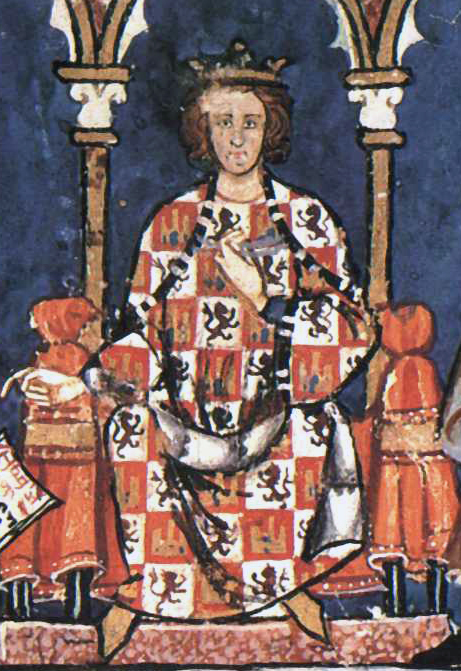
Alfonso X and His Love of Games
Enter Alfonso the Wise (1221-1284), who ascended to the throne of Castile and León after his father passed in 1252. He tried to foster a cosmopolitan court with an eye toward intellectualism. He employed scholars from the Jewish and Muslim faiths, as well as Christian.
Interestingly, he also seemed to favor making knowledge more accessible, as he tasked them with translating works from Hebrew, Arabic, and Latin into vernacular Castilian. Additionally, he decreed that Castilian would be the preferred language for legal purposes, rather than Latin. This lowered the bar somewhat for the public to educate themselves, provided they could at least read their native language. Speaking of which, one of his legal writings, Las Siete Partidas, is part of the founding principles of law in the US today.
Unfortunately, his rule was also steeped in conflict with the nobility, mostly for economic reasons. Eventually, it led to civil war, and the nobility helped his son Sancho IV to claim the right to the throne in 1282 over the son of his elder brother Ferdinand. Sancho ascended to the crown in 1284 after Alfonso X died.
Libro de los Juegos – a Treasure Trove of Games
One of Alfonso’s most significant contributions, at least for our focus on this site, is the Libro de los Juegos (“Book of Games”). This compilation was divided into three main sections: Libro del Acedrex (“Book of Chess”), Libro de los Dados (“Book of Dice”), and Libro de las Tablas (“Book of Tables”). This division was to explore the concepts of games of pure strategy, games of chance, and games with an element of both.
Alfonso completed this project in 1283, only 1 year before his death. It has since become a primary source for historians interested in games known during the medieval period.
If you wish to learn more about the book and history around it, I recommend this dissertation, which was submitted to the University of Arizona in 2009, in part to earn a PhD in Spanish. At over 1,400 pages, it’s worth the exploration, and includes the fully-translated text of the Libro de los Juegos.
A replica of the Libro de los Juegos is visible in the upper left corner.

Greenwich Village Society for Historic Preservation, CC BY-SA 2.0, via Wikimedia Commons
And because chess is a nobler and more honored game than dice or even tables, in this book it is spoken of first.”
Libro de’ Acedrex
A Change in Tone for Games of Pure Chance
Of the three main classes of games, Alfonso preferred those of pure strategy, and devoted the majority of the Libro de los Juegos to chess, including 103 chess problems. After that, he favored the tables games (racing games similar to backgammon). Of course, they involve dice, so he included dice games, but this is the smallest section.
Historically, the Church frowned on gaming in general, forbidding their clergy from playing Azar, Chess, or Tables. But games of chance, especially those with dice, were especially condemned, because they involved forces outside the player’s control.
As a result, it was common for any sort of gaming to be heavily regulated, if not outright illegal. You can see examples of this in Alfonso’s legal text, Libro de las Tafurerías.
“The other [reason] is that even though tables are greater and more beautiful than dice, since they cannot
Libro de los dados
be played without them, it is fitting that we speak of them first.”
Shall We Play?
Fortunately, we’re under no such restrictions, so let’s take a look at the games presented in the Libro de los Dados. I’m not presenting them in the written order, but rather grouping them by complexity and general style of play. In all but one case, players use three dice to make their rolls, and the text always assumes two players. Some of these games could likely accommodate more players, but they may require some modification to the rules.
These first five games are the most simple to play. Two players take turns rolling three dice. The first person to succeed at the goal wins whatever bet was at stake. For clarity, I’ll show 6 dice where players must compare their rolls, but only 3 dice when I just need an example of a winning roll.
Mayores (and Menores)
Players each roll one time. Whoever rolled highest wins, if playing Mayores. If you’re playing Menores, the lowest roll wins instead.
 Yellow wins in Mayores with 12 pips versus 8, while Blue would have won a game of Menores.
To add more players, the best option would be to do so tournament-style. Randomly group players into pairs, with the winner of each match moving on to the next bracket. Continue until the final pair determines a winner.
Par con As (“Pair with an Ace”)
This game is exactly what it says on the package – the first player to roll a pair on two dice accompanied by an Ace (1 pip) on the third wins.
 Here’s one example of a winning roll for Par Con As.
Expanding players for Par con As should be done in a manner similar to sudden death. Players each roll their own set of 3 dice simultaneously. After each roll, check to see if anyone won. If more than one player succeeds, only those players continue rolling until a single player remains.
Tanto en Uno Como en Dos
(“As Much on One as on Two”)
The first player to roll a set in which the total pips on two of the dice is equal to that of the third one wins.
 An example of a winning roll, because 4+2=6.
Multi-player here works like that for Par con As. Each player rolls their own set at the same time, checking after each roll to see if there is a winner. Multiple winners continue rolling until only one player succeeds.
Raffa
The first player rolls as many times as necessary until they achieve a pair on two of the three dice. Then they roll the third die one more time, and the total of the three dice becomes their score. Their opponent repeats this process, and the higher score wins.
 Red wins a game of Raffa with a final total of 16 pips.
Similar to Mayores, expanding the player pool should be done in a tournament-style elimination.
Triga (“Trios”)
Triga introduces a slightly more sophisticated game that acknowledges the probability curve for rolling three dice, even if it doesn’t do so explicitly. Again, players take turns rolling three dice. The first player to roll either par (three of a kind) or triga (a pip total either less than 7 or greater than 14) wins.
There are only 6 possible par rolls, and only 36 possible triga rolls out of 216 different outcomes when rolling 3 dice. (Insert Douglas Adams joke about 42 winning rolls).


Here, you can see all the possible winning rolls in Triga. You may notice that looks like a lot fewer than 42 options. For par rolls, there is only one possible way to roll each three of a kind. For the triga rolls a pair can be combined with a different number 3 ways, depending on which die rolled the odd one out. Three different numbers can be arranged on the dice 6 different ways.


A variant form of Triga adds the concept of a “point” number. If a player fails to roll par or triga on their first roll, then that number (between 7 and 14) becomes an additional winning roll called a “point.” If you succeed in rolling your point number again, you win. However, your opponent rolls your point number first, you lose the game.
In our example on the left, Player 1 rolls a 14 on their first turn. This is neither par nor triga, so it becomes their point number. Player 2 then rolls a 10 as their first throw. This isn’t par, triga, or Player 1’s point. So it becomes Player 2’s point number. Going forward, either player will win if they roll par, triga, or one of the point numbers.
Azar – Ancestor of Modern Craps
Azar builds on this variant rule of Triga. In this game, the par rolls lost their significance. if your first roll is one of the triga values (6 or less, 15 or higher, now called azar), then you win. Now, if you fail to roll one of the azar values on your first roll and instead throw something between 7 and 14, this number is assigned as a point value for your opponent, not yourself. Then, pass the dice to your opponent for their turn.

Player 1 rolls 10, which sets it as the point for Player 2.
Once you’ve had a point number assigned, your options change. When you roll, one of the following possibilities may occur:

Next, Player 2 rolls an 8, assigning it to Player 1 as a point number.
- Azar (<=6, >=15): These values are now called reazar and are losing rolls.
- Point Number: If you roll your assigned number, you win.
- Any Other Number: If your opponent doesn’t have a point number yet, the first one is assigned to them. If they already have a point number, you take this number as an additional point number for yourself.
Once both players have a point number, things become more complicated. Azar rolls get ignored, and point numbers your opponent take for themselves become losing numbers for you. So now, the possible results on your turn include the following:
- Azar (<=6, >=15): Once both players have been assigned points, azar/reazar rolls have no affect. You ignore the result and pass the dice to the other player.
- Point Number: If you roll any of your point numbers, whether the one assigned by your opponent, or one taken for yourself, you win.
- Opponent’s Point Number: If you roll one of the point values your opponent took for themselves, you lose. However, if you roll the point number that you assigned to them with your first non-azar roll, the game is a draw. Return all bets and play a new round.
- Any Other Number: Take this value as a new point value for yourself.
So far, Player 1 has a point number of 8, while Player 2’s point is 10. It’s now Player 1’s turn.

They roll an 11, taking it as an additional point number, and pass the dice to Player 2.
In our example game, it’s Player 2’s turn. They win if they roll a 10. They lose if they throw 11. Nothing happens if they roll azar (3-6 or 15-18) and they pass the turn. If the dice come up 8, then the game is a draw. Any other roll becomes a new point number for Player 2.
Some people confuse Azar with another medieval dice game called “Hazard,” due to the similarity in the names. Hazard is a similar game played with two dice that was developed later. It became popular in England in the 14th century, and was even mentioned in the Canturbury Tales. I’ll go over its rules and history in more detail in another article.
Marlota
Marlota is a greatly-simplified variation of Azar, in which only one player rolls. Both players agree on a bet amount, and roll one die to determine which of them is the active player.
The active player then throws the dice, ignoring any of the azar results. The first number they roll within the 7-14 range is assigned to their opponent as a point value. They keep rolling, now ignoring the azar values and the opponent’s point number until rolling a different result between 7 and 14, which they then take as their own point number.
Now that both players have a point value assigned, the active player keeps rolling until they reroll either their own point number and win, or their opponent’s point number and lose. Any other result gets ignored.
Medio Azar (“Half Hazard”)
Players first agree upon a stake amount, then roll to see who goes first. This game increases the range of azar slightly. A player’s first roll now works a little differently:
- Azar (<=7, >=14): You win one stake, whatever you agreed upon.
- Any Other Number (8-13): This first point number is assigned to your opponent. Both players add 2 more stakes to the pot, so now they will play for 3 times the initial bet.

Player 1 rolls 9. The wager rises to 3, Player 2’s point becomes 9, and Player 1 continues rolling for their point number.
After rolling the first point number for your opponent, you don’t immediately hand over the dice for their turn. Instead, you keep rolling until you get a different point number for yourself. During this time, if you roll:

Next, they roll 15, an azar. The wager rises to 4, and they roll again.
- Azar (<=7, >=14): The bet increases – each player adds 1 stake to the pot.
- Opponent’s Point Number: In this case, roll one more time. If it comes up azar, you win whatever the current bet is. However, if it comes up anything else, this becomes an additional point number for the opponent.
- Any Other Number: This becomes your own point number, and now the bets are locked in, with no further raising.

Then they roll 8, setting it as their point number. It’s now Player 2’s turn.
After determining your own point number, pass the dice to your opponent, and now players take turns rolling. You must roll one of your own point numbers to win the jackpot. All other rolls are ignored once both players have point targets.
Azar Pujado (“Raised Azar”)
This is a variant of Medio Azar, with points being assigned and stakes raised using exactly the same method. The difference comes after both players have point targets and the dice start trading hands for normal turns. Rather than ignoring rolls that don’t match your point, each roll that doesn’t win instead raises the stakes by one. As you can imagine, Azar Pujado can become very expensive, very quickly.
Guirguiesca
This is the only game described which uses two dice instead of three. The game procedure works like Marlota, in that only one player is active during a game. After a winner is determined, the active player passes the dice to the other player and they play again.
Players roll one die to see who goes first, then agree upon a stake. If your first roll is 2, 3, 11, or 12, that is azar, and you win the stake. If you roll between 4 and 10, it is a point number that is now assigned to your opponent. At this time, your opponent may increase the bet by any amount they wish before you roll again.
Now, if you reroll this point number immediately, you win the current pool that has been wagered. If you roll one of the azar values, you immediately lose the wager. Rolling any other point number assigns it to yourself.
Once both you and your opponent have a point number, you must continue rolling. You win only if you reroll your own point number, but you lose if you roll any of the azar numbers or your opponent’s point value.
Panquist (“Sweepstakes”)
Similar to Marlota, the first player rolls for two point numbers between 7 and 14. The first one is the point number for their opponent, while the second is their own point number. In this case, they ignore all azar rolls.
Meanwhile, the second player lays out 4 stakes to risk. Players then take turns trying to roll their point number. What’s interesting here is that the number of stakes you win depends on how you roll your point. Below is a table showing the number of stakes you win for each possible point number.
Wins 1 Stake
Wins 2 Stakes
Wins 3 Stakes
Wins 4 Stakes
Point #7


Point #8


Point #9


Point #10


Point #11


Point #12


Point #13


Point #14


Point #7
Point #8
Wins 1 Stake
Wins 2 Stakes
Wins 3 Stakes
Wins 4 Stakes
Point #9
Point #10
Wins 1 Stake
Wins 2 Stakes
Wins 3 Stakes
Wins 4 Stakes
Point #11
Point #12
Wins 1 Stake
Wins 2 Stakes
Wins 3 Stakes
Wins 4 Stakes
Point #13
Point #14
Wins 1 Stake
Wins 2 Stakes
Wins 3 Stakes
Wins 4 Stakes
Point #7
Wins 2 Stakes
Wins 3 Stakes
Wins 4 Stakes
Point #8
Wins 1 Stake
Wins 2 Stakes
Wins 3 Stakes
Wins 4 Stakes
Point #9
Wins 1 Stake
Wins 2 Stakes
Wins 3 Stakes
Wins 4 Stakes
Point #10
Wins 1 Stake
Wins 2 Stakes
Wins 3 Stakes
Wins 4 Stakes
Point #11
Wins 1 Stake
Wins 2 Stakes
Wins 3 Stakes
Wins 4 Stakes
Point #12
Wins 1 Stake
Wins 2 Stakes
Wins 3 Stakes
Wins 4 Stakes
Point #13
Wins 1 Stake
Wins 2 Stakes
Wins 3 Stakes
Wins 4 Stakes
Point #14
Wins 2 Stakes
Wins 3 Stakes
Wins 4 Stakes
That looks like a lot to memorize, doesn’t it? The good news is that there is at least a partial pattern. First, there are 8 possible point numbers, and we’ll split them in half (Low Four for 7-10 and High Four for 11-14). For Low Four points, you win 4 stakes for the combination with the highest pair, and 3 stakes for the combinations with lower pairs. This is reversed when making a High Four point.
Second, the Low Four combinations are mirrors of one of the High Four points. Each point is paired with one from the opposite set (7 with 14, 8 with 13, 9 & 12, and 10 &11). The stakes for a given combination match that of their opposite by flipping each die over. The single exception to this seems to be 1-1-5 winning only 2 stakes, rather than 3. I can’t help but wonder if that was simply an error made by the scribe when taking down Alfonso’s instructions, or if he misspoke.
In all cases, taking all 4 stakes is called panquist. The winning player will roll to determine the point numbers in the next game, while the loser replaces any stakes that were just won. This does give a slight advantage to the player who won the right to roll the points first, because they haven’t put any money into the game until after the other player has won at least once.
Final Thoughts
While the dice games in the Libro de los Juegos are fairly simplistic, they are interesting from a historical perspective. You can see the evolution of rules through several games, as the winning rolls for Triga become the danger rolls in Azar. You see the development of a “point” roll, and I found the idea of adding more winning combinations during play interesting. You even see their understanding of probability with how the stakes in Panquist are determined. (As an exercise, count how many ways each winning combination can be made).
These games were popular in their time, but gave way to newer crazes that developed later, such as Hazard or Glückshaus. But those are topics for another time.


